Click here to read the article.

Tuesday, June 24, 2008


Monday, June 23, 2008
CC Alumnus visits garden, brings horse manure, and dryer drum method

Below is an account of Rob Freeman '95's visit to the garden. Included in the end is some general advice from him about farming and/or buying local produce in your area. He also recommends some readings and places for further research. This dryer drum method of his was recently featured in NOFA's newsletter as well. It was a pleasure to have him come visit and bring valuable advice about farming in this area as well as some delicious and nutritious horse manure!
-------------------------------------------------------
On June 21st, 2008, Rob Freeman CC '95 who is now an organic farmer in Plainfield, Connecticut, brought a truckload of horse manure and a dryer drum to the garden.
Rob showed me his "dryer drum" method of making raised beds. A dryer drum is a bottomless barrel salvaged from dead clothes dryers. It is a method for doing French double digging in a
more efficient way. It was also partially inspired by the old Thanksgiving
story about Squanto teaching the Mayflower Pilgrims how to grow corn, squash and beans in the mounds with the fish buried in the mound. It begins with digging a hole that approximately the diameter of the dryer drum, only about 3 to 6 inches below the ground. Shovel the dirt into a wheelbarrow or into a pile next to the hole. Put the dryer drum in the hole, and refill the drum with a mixture of the native soil and horse manure, or whatever soil amendments you may have. Then stand on the filled dryer drum to pack it down, as Rob is doing here:

Then pull the dryer drum off:

At this point you have a mound. You smooth out the mound, and you can make a water trapping "bowl" if you like:

And then you have a very nice planting mound. Here I am planting kohlrabi seeds that Rob brought.

Rob has collected a half dozen dryer drums and he fills several at once in a line, and then rakes the mound into a raised bed.
Rob has found that using a rototiller or a tractor makes for "disturbed" soil that doesn't hold moisture as well and requires more frequent additions of soil amendments. Soil is a living thing, and running over it with machines and "beating it into submission" reduces it's quality and sustainability. French double digging with dryer drums is a slow process, but it only needs to be done once every few years, and after the first time you get all the garbage and roots and rocks out. The dryer drum method is a good way to fold in amendments such as horse manure while turning the soil. Be sure to have walking paths in between the raised beds, and to put hay or grass clippings on the beds once the plants are established. A mulch of hay or grass clippings suppresses weed growth and holds in moisture.
If you decide that you want to grow your own food, Rob says you need about 2000 square feet per person. He recommends fingerling potatoes, kohlrabi, heirloom winter squash, heirloom tomatoes (save the seeds!), beets, bush beans, pole beans, pickling cukes, peppers, eggplant, hazelnut bushes, grape vines, paw paw trees, Asian pear trees, gooseberry, currant, blueberry and blackberry bushes and strawberries, and onions and garlic. The garlic can be started from bulbs, the onions work best when started from started plants. He gets his onion plants from www.dixondalefarms.com
Rob feels that one should get to know farmers in your area by buying stuff from them, even if it's just a dozen eggs or a bale of hay. Also you can join the organic farming association. Here in New England it's NOFA (Northeast Organic Farming Association which is at www.nofa.org. Horse farms usually want to get rid of their horse manure. It helps to have a pickup truck or know someone who does, but if you don't, Rob recommends renting a dump truck for a weekend and make several manure runs. Also he recommends collecting your neighbors' bagged leaves and pile them up, and put a layer of horse manure on top of them and let it sit a year. The leaves will heat up under the manure and rot into a nice, reddish soil. After this, you do the double digging method with the dryer drum and mix the amendments with the native soil into nice mounds and/or raised beds.
So gardening and preserving food and becoming self sufficient is the way to get people in your community organized and talking, and the next step is to organize political activism. This Stan Goff article
http://www.alternet.org/environment/86943/?ses=f88f5cbb6d1cae35995655bbfac96cd0
expresses that next step very well.
Rob has found that using a rototiller or a tractor makes for "disturbed" soil that doesn't hold moisture as well and requires more frequent additions of soil amendments. Soil is a living thing, and running over it with machines and "beating it into submission" reduces it's quality and sustainability. French double digging with dryer drums is a slow process, but it only needs to be done once every few years, and after the first time you get all the garbage and roots and rocks out. The dryer drum method is a good way to fold in amendments such as horse manure while turning the soil. Be sure to have walking paths in between the raised beds, and to put hay or grass clippings on the beds once the plants are established. A mulch of hay or grass clippings suppresses weed growth and holds in moisture.
If you decide that you want to grow your own food, Rob says you need about 2000 square feet per person. He recommends fingerling potatoes, kohlrabi, heirloom winter squash, heirloom tomatoes (save the seeds!), beets, bush beans, pole beans, pickling cukes, peppers, eggplant, hazelnut bushes, grape vines, paw paw trees, Asian pear trees, gooseberry, currant, blueberry and blackberry bushes and strawberries, and onions and garlic. The garlic can be started from bulbs, the onions work best when started from started plants. He gets his onion plants from www.dixondalefarms.com
Rob feels that one should get to know farmers in your area by buying stuff from them, even if it's just a dozen eggs or a bale of hay. Also you can join the organic farming association. Here in New England it's NOFA (Northeast Organic Farming Association which is at www.nofa.org. Horse farms usually want to get rid of their horse manure. It helps to have a pickup truck or know someone who does, but if you don't, Rob recommends renting a dump truck for a weekend and make several manure runs. Also he recommends collecting your neighbors' bagged leaves and pile them up, and put a layer of horse manure on top of them and let it sit a year. The leaves will heat up under the manure and rot into a nice, reddish soil. After this, you do the double digging method with the dryer drum and mix the amendments with the native soil into nice mounds and/or raised beds.
Lastly, Rob feels that growing your own food is a way to get people out from their televisions and organized for political activism that we can all agree on, whether left wing or right wing. Few people would be in favor of genetically modified "terminator seeds" or poisoning and eroding millions of acres of Midwest topsoil or seeing people suffer obesity and diabetes from the corn syrup ingredient that is part of most food. A good reference for all this would be a book by Michael Pollan, such as "The Botany of Desire" or "In Defense of Food," or Eric Schlosser's groundbreaking "Fast Food Nation."
So gardening and preserving food and becoming self sufficient is the way to get people in your community organized and talking, and the next step is to organize political activism. This Stan Goff article
http://www.alternet.org/environment/86943/?ses=f88f5cbb6d1cae35995655bbfac96cd0
expresses that next step very well.
Rob hopes that you will check out these links. If you have questions about local agriculture, the dryer drum method or anything else you can get in touch with him at foodnotlawnsct@yahoo.com
Monday, June 16, 2008
Week 3 Update

Hello Sprout! Week 3 is here and a lot more is happening in the garden. After last week's rain and heat wave the pests came out. We have Colorado Potato Beetles, Cucumber Beetles, Flea Beetles, and one other pest whose name I don't know.
The flea beetles are the worst at this point. They have really been going after the eggplants (some of which, I'm sorry to say, may not make it). I'm working hard and learning how to manage them. It's organic farming so it requires more time spent picking off bugs. I've been doing a lot of companion planting, and I've also been making garlic to spray on plants popular with pests.


Since last week many of the crops have started to take off such as the potatoes, peas, melons, and radishes, and more. It's very exciting to see the garden coming alive. I have also been working on the herbs and flowers in the garden. I've planted many culinary and tea herbs as well as edible flowers and berries. All of this should help bring in many more beneficial insects to the garden.
Wednesday, June 04, 2008
Thank You to Seniors


I would like take this time to thank all of the seniors for their dedication and work over the last few years to make Sprout grow and thrive in and outside the garden. Cara, Baylin, Heidi, Kathryn, Linnea, Brian, and Brent all dedicated themselves to making Sprout better and the college more sustainable and healthy. Your passion has manifested in what Sprout has become. So I thank them for their time and hardwork, and I'm sure the college will too for many years to come.
Good luck new graduates and remember Sprout is your home. Feel free to come by at any time for a tour, or maybe another delicious cherry tomato.
June Update: Week 1

As you may or may not know, Sprout received a generous gift from a family foundation to allow us to have a garden manager position for the summer, for the first time ever. This means that we will have someone whose full time duty is maintenance of the garden. This is a tremendous step for us and it means that the garden will be able to produce a much larger quantity of vegetables throughout the summer and fall. It also means that we will able to organize many aspects of Sprout outside the garden that include educational programs and more.
Seizing on the opportunity, I will be the one doing this position. Yes, I have graduated, but I am very excited to stay for the summer and continue work on the garden. I have been here for just over a week and already the garden is looking great. Baylin Coddington came down at the beginning of last week and helped me in preparing the garden and transplanting vegetables from the greenhouse. The space is now looking great and ready to produce.
The vegetables we are growing include: summer and winter squash, carrots, beets, turnips, radishes, lettuces, melons, watermelons, chard, kale, brussels sprout, broccoli, onions, and more. In most cases there are multiple varieties of a type. We are also growing a number of herbs and flowers in the middle section of the garden with the rock pile.
Outside the garden I am currently working with CC Curtiss, the Director of Student Wellness & AOD Education, on an education campaign for the fall and beyond. I am also working with Professor Sue Warren on a freshman seminar that she is offering in the fall entitled "Healthy Choice." I will also be maintaining the Earth Tubs and working with Dining Services on food offerings.
This past Saturday at Reunion Weekend I participated in a panel on sustainability at CC. Also on the panel was Glenn Dreyer, Amy Cabaniss, and a couple of alumni active in sustainability issues. About 50 alumni showed up to the panel and they got very engaged and excited about what we are doing at CC. I spoke mostly about the garden and Earth Tubs. They were very interested and afterward I gave some a tour of both.
Sunday, April 06, 2008
The Conference
Our conference was yesterday and it was a tremendous success. Each panel (and panelist) was very informative and interesting. The panelists truly displayed their passion for the issues that they talked about. I think everyone left the conference feeling much better informed and still optimistic about where we can go even in the face of so much adversity.


Many people came to the conference from Connecticut College and New London. People also really enjoyed the free Sustainable Lunch featuring local and organic: soups (Mangetout in NL), cheese (Beaver Brook Farm), apples, honey (CC Professor Stuart Woroneki), and bread. There was also fair trade and organic coffee from Bean & Leaf in New London along with some other drinks and baked goods. The live jazz, organized by Brent Thomas, was the perfect touch on a delicious meal.
A special thank you is deserved for all the students who have worked so hard this semester to make this event a reality and to many other members of the CC community, from Dining Services, who donated time and materials, to all of the departments and offices that made donations to this cause. Thank you!
Below are a few pictures from some of the panels and from the lunch. ** The conference was also videotaped so if you are interested in a DVD of the conference please send us an email.
Wednesday, April 02, 2008
Food with Though: an interdisciplinary conversation about food and agriculture
**The food conference is this weekend! I have uploaded the schedule of events. I hope to see you all there!**
10:00-11:15: Sustainable Agriculture and the Community (Ernst Common Room)
Panelists:
Movie on Friday, April 4
7pm-9pm: King Corn - This documentary is about two friends who follow corn into the food system and what they find raises troubling questions about how we eat and farm.
Panels on Saturday, April 5
10:00-11:15: Sustainable Agriculture and the Community (Ernst Common Room)
Panelists:
• Bryan Connolly: Bryan is professor at the University of Connecticut and a former professor of Connecticut College. He is a renowned local agriculture expert. Bryan will discuss definitions of sustainable agriculture and its practical implementation.
• Art Costa: Art is a director of Re-New London, a broad organization working towards the localization of New London companies, educational opportunities, and community outlets. Art will speak towards the type of work that Re-New London does and why community unification efforts are important and possible.
• Brent Thomas: Brent is a senior Government major at Connecticut College. He will speak about farm subsidies and the formation of industrial agriculture.
• Arthur Lerner: Arthur is a co-founder of F.R.E.S.H. New London. F.R.E.S.H. works to implement and guide practical, agricultural & gardening projects in New London as a way to educate and empower citizens towards personal wellness, community health, and environmental stewardship. Arthur will discuss the importance of local, sustainable food and the relationships it fosters among farmers and the surrounding community.
11:30-12:45: Panel on the Health of Humans and the Environment (Ernst Common Room)
Panelists:
• Katie Jeffrey-Lunn: Katie is a local nutritionist for FitNutrition, LLC in Mystic, CT. She specializes in nutrition counseling, her presentation focuses on the health of organic and local foods.
• Bart Staub: Bart is an ayurvedic consultant from the Kripalu Center for Yoga and Health in the Berkshires of Massachusetts. He will be talking about a holistic approach to health and nutrition as well as eating with the seasons.
• Tammy Collier: Tammy is one of the Connecticut Chapter leaders of the Weston A. Price Foundation which focuses on restoring nutrient-dense foods to the human diet through education, research and activism.
2:00-3:15: Panel on Social Justice and Human Rights (Ernst Common Room)
Panelists:
•David A. Canton: David is an African Studies Professor specializing in 20th Century American Social History, the Civil Rights Movement, and Urban History. He'll be talking about Martin Luther King Jr. and the Human Rights movement.
• Manuel Lizarralde: Manuel is a Connecticut College Botany Professor. His talk will focus on the production of ethanol involved with producing food.
• Davis Lewis: David is an owner of Flavours of Life, the fair trade store in New London. He is also a very active member of the New London community. He will be talking about fair trade.
Saturday, March 29, 2008
Our Table at the Fiddleheads Market
On Saturday, March 29th we had a table at the Fiddleheads Market, which is a winter/spring farmer's market that just started up at the Fiddleheads Food Co-op every Wednesday and Saturday from 10am-2pm. It is a great place to go every week to find delicious local and organic produce from area farmers...and it's wonderful environment too with live music and happy people.
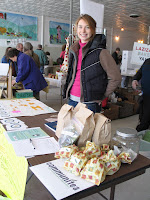
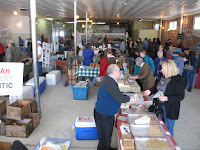
At the market we sold some lettuce and lemon verbena tea. Both were very popular and the lettuce sold out in only 20 minutes! We were also advertising for the upcoming food conference. We are hoping to have many people there from CC and the New London Community.
Below are a couple images. One of a view of the market and another of Heidi Cook at our table. Brent Thomas was also there at the market to help out.
Monday, March 24, 2008
what's possible
As the signs of Spring appear around us with blooming flowers and chirping birds, our garden continues to thrive. Having returned from Spring Break, I went today to check out the status of the lettuces planted in the Fall...they live. All of the many varieties of lettuce that we planted survived the winter with no maintenance. It seems remarkable, but what this proves is that anyone, with hardly any labor, can have lettuce to eat all winter long. All that is needed is a little wire and some plastic covering (even a shower curtain would work). This little experiment of ours was a success and next winter I can only expect that we will be able to improve our modest harvest.


Below is some freshly harvested lettuce (my dinner tonight) and another image of lettuce growing under the plastic covering.
Happy Spring!
Misha
Monday, March 17, 2008
Earth Tub Composting Update
We are now composting in ALL OF THE DINING HALLS ON CAMPUS. This semester we have added Harris, Knowlton, and Smith dining halls to the list of places that we pick up food waste from. We now get hundreds of pounds every day and we are rapidly filling the tubs. After a slight learning curve from students and staff, the idea of composting is now catching on, and people are very enthusiastic about the amount of waste that is now being diverted from the piggery. The first batch of compost is going to Sprout and the second batch will be going to FRESH.


There was also an article recently published in E (the Environmental Magazine) with a section on the composting project featuring Tyler Dunham and Misha Johnson. Click here.
Below, Alana Harris and Mike Seager transport food waste from the dining halls to the Earth Tubs, and a look inside of one of the tubs with newly added food waste.
Maple Syrup March Madness
In late February, just a couple weeks before Spring Break we started to tap some sugar maple trees for sap. This project came to fruition with the guidance (and some extra materials) from Jim Luce and the initiative of Brent Thomas and Liz Wall. We tapped about a dozen sugar maples and then just before break we tapped a few red maples, which yield a sap with slightly less sugar content, so it takes more sap to make the same amount of syrup. For sugar maples it takes about 40 parts sap to make 1 part syrup. It takes about 12 hours to boil down the sap, which we have been doing in the kitchens of the dormitories Abbey House and Earth House.
This whole project is tremendously exciting and it allows us to continue our goal of showing what is possible in the area that we live in. Maple syrup is a sustainable alternative to imported refined sugars. And of course it is DELICIOUS!
Below, Brent Thomas and Eric Dooley-Feldman gather the sap from some trees and then filter and boil it in Earth House.


Tuesday, February 12, 2008
Yearly Report and February Update
Please follow the link below and click on "Yearly Report for 2007" to check out a summary on what happened this past year and what we are looking ahead to for this new one.
We have hit the ground running this semester and are working on having many events including a conference focused around food issues in early April. I will write again soon with more details on that and our other projects.
Monday, December 17, 2007
Done for the Year
As finals are wrapping up for students around campus so too have we been tying somethings up with the garden. We had our last workday a couple weeks ago and now the only thing out there are the lettuces, which are still surviving under the thick layer of snow and ice that now coats the campus.


We're currently looking ahead to next year and working out where the garden will be going. Over the winter break I will be publishing our yearly report. Below are a couple pictures with some Sproutees from our last meeting of the year and some mizuna under cover in the garden.
Happy Holidays,
Misha
Monday, November 26, 2007
Garden Update
While the garden is mostly asleep for the winter we are still working on a few projects. The winter lettuces are doing very well, and were very popular when delivered to the dining hall a couple weeks ago. If all goes well we should be able to continue to harvest them for quite a while longer.
The spearmint is still growing strong, though it will be harvested soon. And will hopefully be delivering some lemon verbena to Bean & Leaf café in New London quite soon.
We are also working on the shed. It is coming along quite nicely. This is our main project right now. The goal is to have it finished by the end of the semester.


Composting Project Opening Ceremony November 19th
On Monday November 19th we had the opening ceremony for the composting project. Many students, faculty, and staff came down, and there were news crews from the Day and Channel 3. Tyler Dunham and I made short speeches and introduced CC president Leo Higdon, who spoke about the importance of this initiative for the College and the New London Community. We then did a demonstration and a ceremonial "Dump 'n Grind" (as the ceremony was called).
The event was on the Channel 3 evening news:
mms://streaming.vmsnews.com/media/wsxtemp/9142908D-BE95-4392-8A06-9E50047AC021.wsx
It was also featured in the Day newspaper:
http://www.theday.com/re_print.aspx?re=8ac304eb-4a40-4cb0-83ba-d07d0b78d525
And on the Connecticut College homepage:
http://aspen.conncoll.edu/news/3867.cfm
If you have any questions or comments about the project please feel free to send us an email.
Sunday, November 04, 2007
Real Food Conference @ Yale and Recent Workday
Saturday and Sunday Liz Wall, Stephanie Blennerhassett and I went to the Real Food Summit at Yale. It was an event organized for the purpose of bringing together people from universities all around New England to discuss the ideas and projects that we all have. There was a mixture of speakers and smaller discussion groups based around different issues that are trying to be tackled in the sustainable food movement. It was a time for sharing ideas as well as hearing those of others. Every school (47 in all) had a different context that they were coming from but each had something to offer, whether it was advice or a novel idea. The conference also gave a sense of being part of a greater movement that is happening not only in New England but also across the country and around the world. I think we all learned a lot and personally I've come back with ideas flowing like Niagara. I, and I think Liz and Stephanie too, would love to share what I learned with all of you as well. We will hopefully do that at the meeting next week. We also picked up some really interesting materials that we should be able to use this on campus to educate the student body and create a more sustainable dining system...As always feel free to contact me with any questions.
Today we had another work day (that Baylin ran). He and a few other people fixed up the cold frames that have been set up and are now covering some of the head lettuce. The beets, cover crops, hot peppers, and loose leaf lettuces are still going strong as well. The tomato plants were also taken out and are hanging upside down outside Earth House. Evidently we can leave them hanging upside down for a few months and the tomatoes will ripen. The shed also got worked on this week and the walls are continually looking better. Keep up the good work everyone!
Today we had another work day (that Baylin ran). He and a few other people fixed up the cold frames that have been set up and are now covering some of the head lettuce. The beets, cover crops, hot peppers, and loose leaf lettuces are still going strong as well. The tomato plants were also taken out and are hanging upside down outside Earth House. Evidently we can leave them hanging upside down for a few months and the tomatoes will ripen. The shed also got worked on this week and the walls are continually looking better. Keep up the good work everyone!
Tuesday, October 23, 2007
October 21st Workday
This workday was tremendously successful. We had a nice large group show up and it allowed us to do many of the important things that needed to be done before a frost comes (although it probably wont be coming too soon). We weeded the new Fall and Winter lettuces, cleared out a lot of the built-up leaf litter and rocks, broadcast more buckwheat, cleared so more land to expand the garden, and laid down more compost. The Fall and cover crops are coming up really well (The rye is the "grass"-looking plant in the pictures. The buckwheat and a couple of the loose-leaf lettuces are also pictured). Everything is certainly made much easier by the fact that it is not cold yet. Other crops like our tomatoes, eggplants, and peppers are still alive but not producing as much fruit, possibly because of the diminished amount of light reaching them. It's all still delicious though.


Tuesday, October 09, 2007
Recent Workdays
We've had quite a lot of workdays recently. We've been bagging tea, broadcasting cover crops, tending to our Fall crops, harvesting, and gathering compost for the garden. It hasn't been raining much although it is supposedly in the forecast, and the weather (although uncomfortably balmy) has allowed our tomatoes, eggplants, zucchinis, beets, and herbs to keep on growing strong.


Sustainable Dinner on October 3rd
Dining Services, with the initiative of Kristine Serwinski, hosted a Sustainable Dinner. The meal set outside of JA, was catered by 5 local farms that have been providing foods to the dining halls. Sprout was also there talking with people about our club while also educating students about local, organic, and sustainable agriculture. Many students showed up to enjoy the delicious local feast. They also filled out surveys, learned more about the individual farms, and talked to farmers.


Monday, October 01, 2007
Harvestfest and More...


A lot was done this past week for Sprout. We sold pumpkins, zucchini bread muffins, jars of tea, salsa, and tomato sauce for Harvestfest (everything was homemade). Our table was very popular and almost sold out of everything. It was a great fundraiser for us.
This Sunday at the workday we planted the rest of the lettuces (for a total of 6 wide beds), and we will continue to plant successions of others as the Fall progresses. The cover crops will also be going in the ground this week.
And the Earth Tubs arrived on Friday! We will probably start composting right after Fall Break.
Subscribe to:
Posts (Atom)